
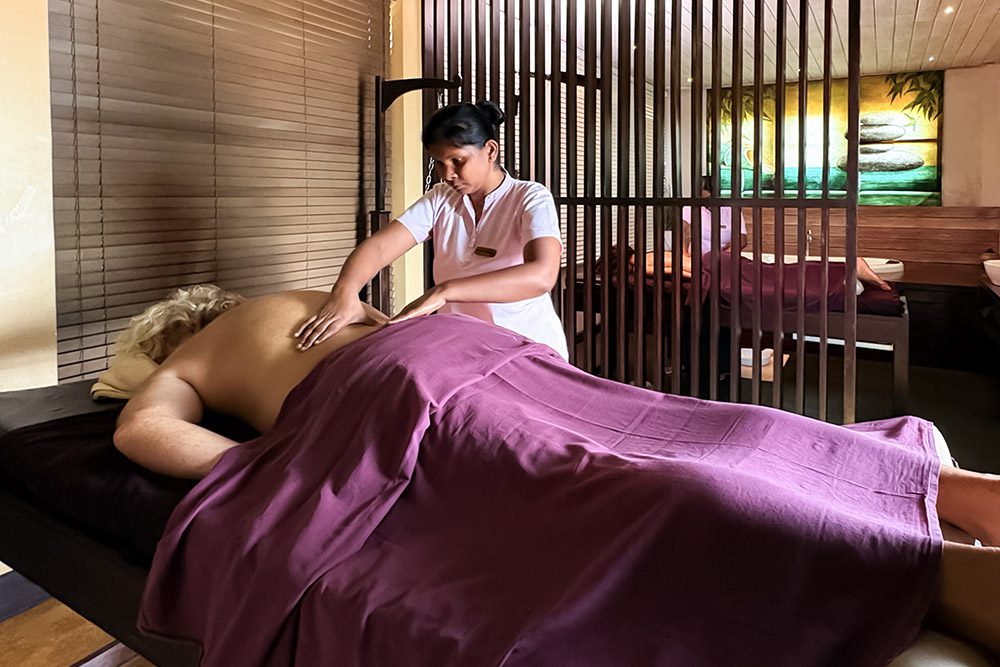
What can two hours of Ayurveda offer after a long-haul flight?
Long-distance travellers know how punishing many hours in a cramped airline seat can be.
Your body has arrived in Sri Lanka, but the rest of you seems to have been left somewhere over the Indian Ocean.
Your shoulders are stiff. Your legs have spent hours in one position. Your skin feels dry. Your eyes are tired. Your sleep cycle is completely out of kilter with local time.
And although you may be looking forward to your holiday, your nervous system doesn’t seem to have got the message!
This is where two hours at Spa Secret, the rooftop Ayurveda spa at Terrace Green Hotel & Spa in Negombo, makes sense.
The experience is not a magic-bullet ‘cure’ for mind-body woes, and it would be misleading to suggest that Ayurveda can instantly reset the body’s biological clock.
Jetlag is a real circadian-rhythm disorder caused by rapidly crossing time zones, and can involve sleep disruption, daytime sleepiness, impaired concentration, malaise and gastrointestinal symptoms.
But there is another effect of long-haul travel: physical and mental fatigue. Which is when warm oil, rhythmic massage, heat, quiet and uninterrupted time to unwind can make physiological sense.
Which is particularly relevant on International Relaxation Day, celebrated on 15 August.
What happens to mind and body during a long-haul flight?
Aircraft cabins are pressurised, but not to sea-level. Commercial aircraft typically maintain pressure equivalent to an altitude of roughly 6,000–8,000 feet. Cabin air is also unusually dry, commonly around 10–20% relative humidity.
For most healthy travellers this is not a serious problem, but it can contribute to dry eyes, dry nasal passages and dry skin.
Then there is the prolonged sitting. For hours, your body occupies essentially the same posture while your muscles perform very little of their normal movement.
Add restricted personal space, artificial light, cabin noise, disrupted meals and sleep, and the result is physical discomfort and mental overstimulation.
Then there is the body clock.
Crossing several time zones forces the internal circadian system to adjust to a new light-dark cycle. The Centers for Disease Control and Prevention in the US (CDC) describes jetlag as a temporary desynchronisation between the body’s internal clock and local time.
So when you walk into an Ayurveda spa after a long flight, you are not simply tired. You are dealing with several different forms of travel fatigue at the same time.
Why Abhyanga makes sense after flying…
Abhyanga is the traditional Ayurvedic full-body oil massage.
Spa Secret therapies include the 60-minute Abhyanga treatment, when warm aromatic oils are massaged into the body; a 90-minute Ayurvedic full-body massage with heated herbal pouches; a 90-minute massage with herbal steam bath; a 90-minute massage combined with Shirodhara; and a 120-minute Ritual of Ayurveda combining full-body massage, Shirodhara and herbal steam.
There is an important distinction between the traditional Ayurvedic treatments and modern physiology.
Ayurveda places Abhyanga within its own traditional framework of doshas, balance and mind-body wellbeing. Modern medicine does not establish those traditional concepts as physiological mechanisms.
However, modern physiology does provide plausible explanations for why the experience of warm oil and massage can feel so effective after a long journey.
Warmth matters…
Warmth is one of the simplest ways of making a tired body feel rested.
A warm treatment environment and warm oil stimulate temperature-sensitive receptors in the skin.
Heat can promote relaxation and, depending on how it is applied, increase local blood flow and reduce the subjective sensation of muscular stiffness.
Research at PubMed Central into heat and massage has found evidence of effects consistent with autonomic relaxation.
The point is not that warm oil somehow reverses the effects of cabin pressure. It doesn’t. Rather, warmth provides a form of sensory contrast.
You have spent hours in a cool, dry, mechanically ventilated environment wearing restrictive clothing and sitting in one position.
Suddenly there is warmth, touch, movement and time to relax and unwind. The nervous system sits up and takes notice!
Massage provides an antidote…
There is another simple physiological principle at work.
During a flight, your body is largely inactive but your brain remains engaged: announcements, screens, conversations, airports, security, unfamiliar surroundings and the constant awareness of time.
An Ayurveda massage changes that relationship. It provides soothing sensory input, reduces perceived muscle tension and promotes a state of relaxation.
Research into massage has found associations with changes in heart rate, blood pressure and stress-related hormones, although the evidence varies according to the type of massage.
What does parasympathetic ‘reset’ actually feel like?
‘Resetting the nervous system’ is popular wellness language, but it is not a medical description.
Your autonomic nervous system continuously balances sympathetic activity—associated broadly with alertness and mobilisation—with parasympathetic activity, which supports functions associated with rest and recovery.
A relaxing massage does not switch off the sympathetic nervous system and switch on the parasympathetic system like a light switch.
What you may experience instead is a shift towards a calmer physiological state:
- Your breathing becomes slower.
- Your shoulders drop.
- Your jaw unclenches.
- Your muscles stop feeling as though they are bracing themselves.
- Your thoughts become less insistent.
- You may become pleasantly sleepy.
Some people describe a sense that their body has suddenly become heavier. Some experience a warm, floating sensation. Others simply embrace the fact that for the first time in 14 hours, they are no longer thinking about the journey!
This is not a mystical ‘reset’. It is the subjective experience of moving from sustained alertness and stimulation towards calm restfullness.
Buddhism and the mind-body connection…
There is another reason Ayurveda feels particularly at home in Sri Lanka: its understanding of wellbeing sits within the same broad South Asian tradition of thinking about the relationship between mind and body that profoundly influences Buddhism.
But Ayurveda and Buddhism are not the same system, and Ayurveda should not be described as a form of Buddhist medicine.
Ayurveda developed as a distinct medical tradition. But both emerged within an intellectual culture that did not draw the modern Western distinction between a physical ‘body’ and a separate ‘mind’ quite so sharply.
In Buddhist thought, the condition of the body and the condition of the mind are closely related to the human experience of wellbeing and suffering.
Physical discomfort can influence mental states; anxiety, agitation and stress can in turn influence how bodily sensations are experienced.
Buddhist practices such as mindfulness therefore pay close attention to bodily sensations, breathing and the constantly changing relationship between physical experience and mental awareness.
Ayurveda approaches the relationship differently, using its own concepts of balance, constitution and wellbeing.
Yet the practical objective can sometimes appear remarkably familiar: creating conditions in which the person becomes calmer, more aware and less physically and mentally agitated.
That makes the experience of an Ayurvedic treatment after a long flight particularly appropriate. You are not simply treating tired muscles. You are giving both body and mind an opportunity to stop, become still and recover from the demands of the journey.
Why two hours can be better than a ‘quickie’…
There is a practical reason for choosing a longer treatment after a long flight.
A 30-minute massage may feel wonderful, but two hours gives the transition itself time to happen.
Spa Secret’s 120-minute Ritual of Ayurveda combines a full-body Ayurvedic massage, Shirodhara, and a herbal steam bath.
The sequence matters psychologically as much as physically.
- First comes the recognition that the journey is over.
- Then comes touch and warmth.
- Then stillness.
- Then another period of heat and relaxation.
The result is not necessarily that you are suddenly free of jet lag. Your circadian clock will still need time, daylight and sleep to adapt.
But you may be considerably better prepared to let that adaptation happen.
Shirodhara: why the forehead treatment feels so different…
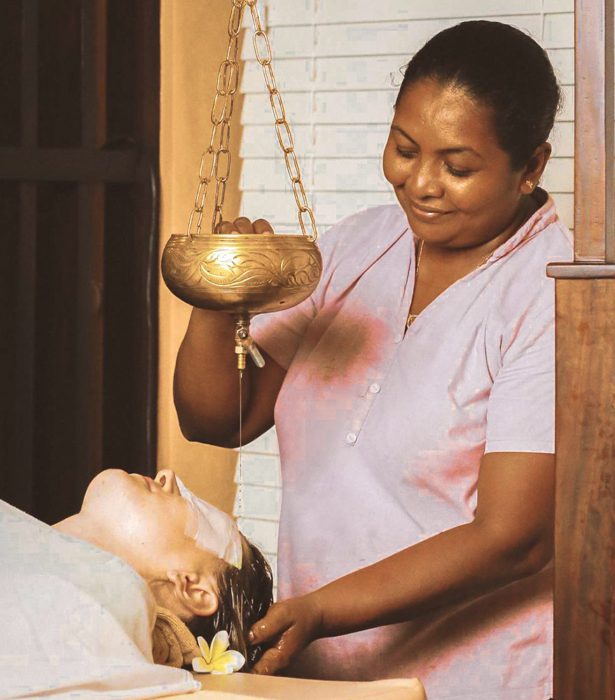
Shirodhara is one of the most distinctive therapies associated with Ayurveda.
A continuous stream of warm herbal oil is directed onto the forehead while the guest lies comfortably on the treatment table. The treatment includes a relaxing head massage.
Traditional Ayurveda attributes particular significance to this area of the forehead.
Modern physiology does not support claims that a stream of oil onto the ‘third eye’ directly controls the brain or cures jet lag.
But there is a perfectly reasonable sensory explanation for why Shirodhara can feel profoundly calming.
The forehead and scalp contain a dense network of sensory receptors. A slow, repetitive and predictable sensation, combined with warmth and an absence of external stimulation, is deeply relaxing.
For someone who has spent 14 hours surrounded by engine noise, screens, announcements and movement, that sensory simplicity can be powerful.
Which Ayurveda treatment should you choose after a long flight?
Abhyanga massage
Best suited to the traveller who feels physically stiff, dry, tired and generally travel worn.
It is the classic warm-oil full-body treatment and probably the most straightforward introduction to Ayurvedic massage. Spa Secret offers it as a 60-minute treatment.
Abhyanga with herbal pouches
A 90-minute treatment combining oil massage with heated herbal pouches applied to selected areas of the body.
The additional warmth and pressure make this particularly appealing if the main problem is muscular stiffness after prolonged sitting.
Abhyanga with herbal steam bath
This combines the full-body Ayurvedic massage with a herbal steam bath. It is a good choice for someone who wants the experience to continue beyond the massage itself.
Abhyanga with Shirodhara
This 90-minute treatment combines full-body Ayurvedic massage with Shirodhara. It is particularly effective if physical fatigue and mental overstimulation have arrived together.
Shirodhara
A 50-minute treatment concentrating on the head and forehead rather than the whole body. It is worth considering if your principal complaint after travelling is mental fatigue rather than muscular stiffness.
The ritual of Ayurveda…
For the traveller who wants the full two-hour experience, this is the obvious choice. It combines full-body Ayurvedic massage, Shirodhara and a herbal steam bath in one 120-minute treatment.
Does Ayurveda cure jet lag?
No. There is no good evidence that an Ayurvedic treatment can instantly cure jet lag.
Jet lag results from circadian disruption after rapidly crossing time zones. Recovery depends primarily on the body’s gradual adjustment to the new light-dark schedule, sleep timing and other environmental cues.
Ayurvedic treatments may nevertheless help a traveller relax and feel physically more comfortable while that adjustment happens.
Does Abhyanga improve circulation?
Massage can increase local blood flow, and movement of soft tissues may temporarily influence circulation. It is reasonable to describe Abhyanga as promoting relaxation and local circulation.
Does warm oil ‘detox’ the body?
Not in the medical sense. But warm oil moisturises the skin, and the warmth and massage is relaxing. And ‘toxins’ have little to do with why an Ayurveda massage feels so restorative.
Why is warm oil used in Ayurveda?
Warm oil is traditionally central to Abhyanga. From a modern physiological perspective, warmth provides soothing sensory stimulation, while massage provides mechanical stimulation of the skin and underlying tissues.
Can Shirodhara make you sleepy?
It can certainly be experienced as deeply relaxing, and some people may become sleepy during or after treatment. That is not the same as demonstrating a specific neurological mechanism unique to Shirodhara.
Is two hours too long after a flight?
For many healthy travellers, a two-hour treatment can be a very soothing way to transition from travelling to resting.
However, anyone with significant medical conditions should discuss massage, heat treatments or prolonged lying positions with an appropriate healthcare professional.
What should I do after the treatment?
Drink normally, eat a moderate meal, avoid immediately filling the evening with activities, and give yourself an opportunity to sleep at the local time.
Remember: If you have crossed multiple time zones, the spa can help you relax, but it cannot adjust your circadian clock overnight.
The real benefit: allowing the body to go slow…
After long hours of travel, what many people need is not another attraction, another excursion or another decision.
They need to decompress.
Terrace Green Hotel & Spa is close to Bandaranaike International Airport, and Spa Secret is a rooftop Ayurveda and wellness retreat rather than simply a place to have a conventional massage.
That makes the combination particularly appropriate for that first day in Sri Lanka.
The spa gives your body a chance to catch up. Which is perhaps the best way to think about Ayurveda after a long-haul flight.
Not a miracle cure, nor a substitute for sleep or medical treatment. But as an ancient system of relaxation whose traditional practices have some surprising parallels with what modern physiology tells us about stress, fatigue and recovery…