
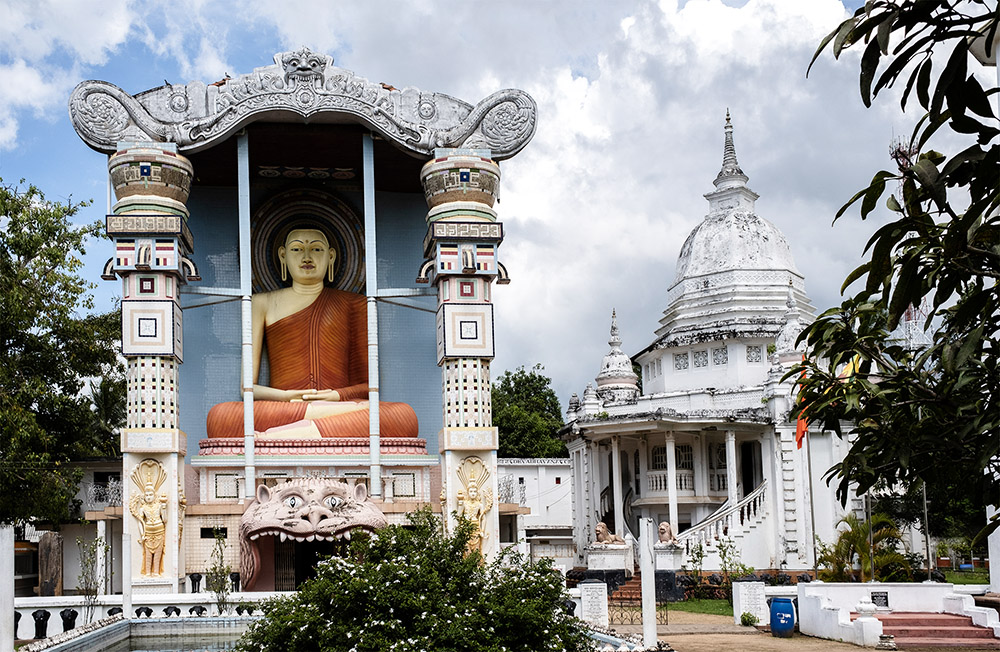
Negombo’s landmark Buddhist temple an historic religious and cultural sanctuary
Bodhirajarama Maha Viharaya, more commonly known as Angurukaramulla Buddhist Temple, is a significant Buddhist religious site in Negombo, Sri Lanka.
In a city predominantly known for its Catholic heritage, this temple stands out as a central place of Buddhist worship and cultural heritage.
The origins of the temple trace back to the late 19th century, when an initial parcel of land for a Buddhist temple at Angurukaramulla was donated in 1868 to Kirimetiyawe Revatha Thera.
This proved too small for a full temple complex, and additional land for the present site was later provided by Simon de Silva Mudali.
Golden era
The period between 1930 and 1955 is often described as the ‘golden era’ for the temple under M.B. Sri Medhankaratissa Thera, a monk who expanded its religious and social role within Negombo.
A significant refurbishment took place in 1939, enhancing the temple’s facilities and opening them formally for public veneration.
Architectural and artistic features reflect a blend of Sri Lankan Buddhist symbolism and local decorative styles.
The temple’s most striking exterior element is its dragon-head entrance (Makara Thorana) and monumental seated Buddha statue, approximately 6 meters tall, installed in the 1980s.
Open jaws
Visitors enter the main shrine room through the open jaws of the mythical creature, a motif intended to ward off evil and invite devotees into the sacred space.
Inside the Buduge (shrine room), murals and paintings depict scenes from the Buddha’s life and Jataka tales.
These artworks, alongside wood and stone sculptures, represent both religious narratives and historical figures from Sri Lanka’s past, including life-size renderings of Sinhala kings and queens from Vijaya to Sri Wickrama Rajasinghe.
The interior art carries artistic influences that echo broader Sri Lankan Buddhist traditions.
Historical
The temple complex also includes a library building of historical note, inaugurated in 1941 by Sir Andrew Caldecott, then Governor of British Ceylon.
This structure historically served as a repository for Buddhist scriptures and literature, though it now remains largely in a neglected state.
Today, Bodhirajarama Maha Viharaya functions as both a religious sanctuary and a cultural landmark in Negombo, drawing local worshippers and international visitors interested in Sri Lanka’s Buddhist heritage.