
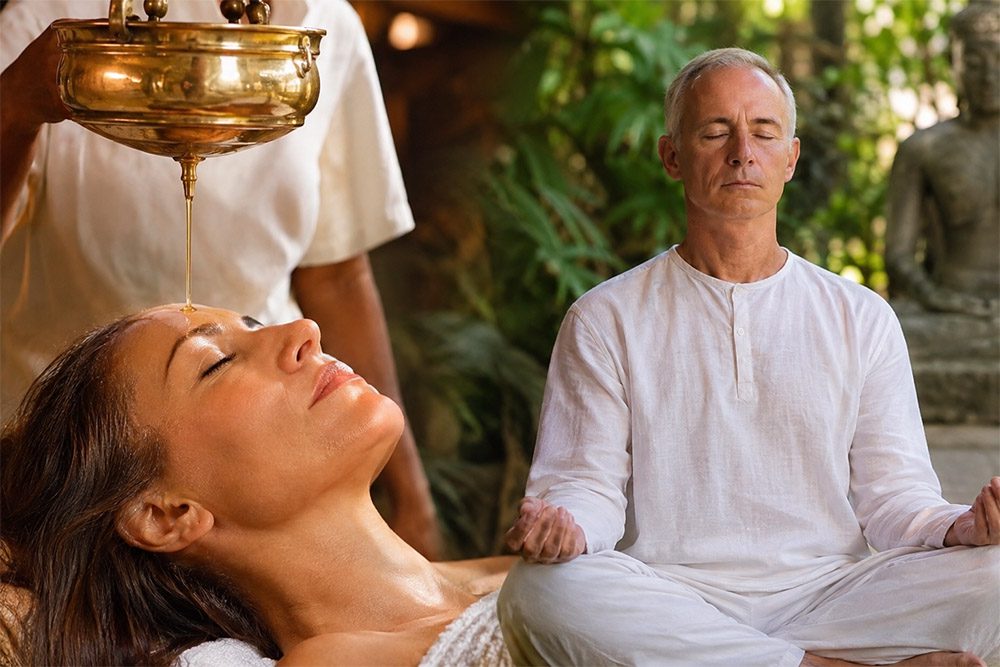
Ayurveda and Buddhist meditation: The shared promise of mind-body wellness
Ayurveda and Buddhist meditation both originated in ancient India over 2,500 years ago, and have deep historical and mind-body wellness roots.
They share what took Western medicine another two thousand years to take seriously: that mind and body are not separate systems to be treated in isolation.
But there are differences.
Ayurveda works on the body directly—through diet, herbs, massage, and a structured daily routine known as dinacharya—to balance three bodily energies called doshas: vata, pitta, and kapha.
Buddhist meditation (Buddhism Now) works from the other direction—through breathing awareness (anapanasati) and body-centered insights (vipassana)—to affect how the mind relates to bodily sensations.
And understanding where these two systems meet and overlap gives a more complete picture of what ‘wellness’ actually means.
What connects Ayurveda and Buddhism?
Both traditions trace back to the Gangetic plain of ancient India in roughly the sixth century BCE—the same cultural and intellectual environment that produced early Ayurvedic medical thought and the teachings of Siddhartha Gautama, the historical Buddha.
There is a connection. Early Buddhist texts describe Jivaka Komarabhacca, a physician trained at Taxila who became personal doctor to the Buddha and treated him and his monastic community using the medical theory of the day—the same elemental framework (earth, water, fire, air, space) that underlies Ayurvedic dosha theory.
This shared vocabulary shows up throughout the early Buddhist scriptures, where the body is repeatedly described in physical, almost clinical terms—skin, sinew, bone, marrow—as an object of direct observation rather than an abstraction.
So while Ayurveda and Buddhism didn’t develop identical systems, they drew from the same well of ideas about what mind and body are and how they can drift out of balance.
How do the two systems each define mind-body wellness?
Ayurveda’s model centers on the three doshas: Vata governs movement—breathing, circulation, nerve impulses; Pitta governs transformation—digestion, metabolism, body temperature; and Kapha governs stability, strength and endurance.
Thus illness, in Ayurvedic terms, is what happens when one dosha moves too far out of its natural range. Treatment aims to bring it back, primarily through diet, routine, and lifestyle rather than isolated symptom management.
Buddhism approaches the same thing from the study of experiences rather than physiology. Its core model is the five aggregates (skandhas): form, sensation, perception, mental formations, and consciousness.
Rather than mapping the body’s energy balance, it maps how a person relates to those moment-to-moment experiences—and it locates suffering not in the body itself but in the mental reactions layered on top of physical sensation.
Put side by side, the two frameworks are addressing the same underlying question from opposite ends: Ayurveda asks what state the body is in and how that shapes the mind; Buddhism asks what the mind is doing, and how it shapes the body.
Neither treats mental and physical health as separable. A vata imbalance and an anxious, scattered mind are, in both systems, versions of the same thing—one described physiologically, the other experientially.
Where the two physically overlap
The clearest overlap between the two systems is breathing. Ayurveda uses pranayama—structured breathing techniques—to directly regulate vata and, through it, the nervous system.
Buddhist meditation uses anapanasati, or mindfulness of breathing, as the primary object of concentration in nearly every meditation lineage that traces back to the Buddha’s own instructions.
Both practices are doing the same thing: slowing and deepening respiration that shifts the autonomic nervous system out of a stress-dominant state and into a rest-and-digest one.
Slower, fuller breathing lowers heart rate, increases heart-rate variability, and reduces circulating stress hormones, effects that show up whether breathing is devotional or medical.
The second overlap is digestion. Ayurveda treats agni, or ‘digestive fire’ (OneWorld Ayurveda), as one of the most important indicators of overall health. Weak agni is blamed for everything from fatigue to skin problems to a sluggish mind.
Modern research on the gut-brain connection, and specifically on the vagus nerve, describes something structurally similar: the vagus nerve (Cleveland Clinic) runs directly between the gut and the brain, and is responsive to breathing patterns and stress states.
A dysregulated nervous system tends to present as a dysregulated gut, and vice versa—close to what Ayurvedic physicians have argued for centuries using different terminology.
The third overlap is sleep. Both systems treat sleep disruption as a whole-body problem rather than an isolated symptom.
Ayurveda ties insomnia most often to aggravated vata, ie, too much stimulation, irregular routine, and a mind that won’t settle.
Buddhist teachers describe a similar mechanism from the inside: an untrained mind that keeps generating thought after the body is ready to rest.
The prescriptions converge, too. Both traditions point to a wind-down routine, reduced evening stimulation, and a consistent bedtime as the single most effective intervention.
A combined daily routine
You don’t need to choose one tradition over the other. A short daily sequence built from both is more practical than adopting either full system on its own:
- Wake at a consistent time, close to sunrise. Ayurveda’s dinacharya treats a fixed wake time as the foundation everything else is built on, since it sets the rhythm for digestion, energy, and sleep later that night.
- Ten minutes of anapanasati before anything else. Sit upright and breathe through the nose. This is the meditation technique most directly documented in early Buddhist texts.
- End with a dosha-appropriate breathing technique. If you are anxious or ‘scattered’ (vata-dominant), a slow, extended exhale is grounding. If you are irritable or overheated (pitta-dominant), a cooling breath through the mouth works better. If you are sluggish or heavy (kapha-dominant), a faster, more energizing breathing pattern helps.
- Eat tour main meal when digestion is strongest. Ayurveda places this at midday, when agni is at its peak—a detail that lines up with the broader modern interest in eating earlier in the day.
- A short mental scan of the body, from head to toe, before sleep. Vipassana’s core technique—moving attention slowly through physical sensation without reacting to it—doubles as an effective wind-down practice and needs no meditation experience to attempt.
None of the above requires adopting either tradition wholesale. The overlap is the point: where Ayurveda and Buddhist meditation independently arrive at the same place, thus it’s likely that the underlying mechanisms are real and worth trying.
FAQ
Is Ayurveda part of Buddhism?
No. They’re related but independent systems that developed alongside each other in ancient India. Ayurveda is a medical system; Buddhism is a philosophical and spiritual path that includes meditation. They share historical roots and some conceptual vocabulary, but neither is a subset of the other.
Can you practice Ayurveda and Buddhist meditation together?
Yes, and many people do, often without labeling it that way. A daily routine that includes breathing-focused meditation, consistent sleep and meal schedules, and attention to your dominant dosha combines both without requiring formal training in either.
What’s the difference between pranayama and anapanasati?
Pranayama is a broad category of breathing techniques used in Ayurveda and yoga to actively regulate respiration—extending, restricting, or altering its pattern to affect a specific dosha or physiological state.
Anapanasati is a meditation technique that sees respiration as it naturally occurs, without controlling it, to build concentration and awareness.
Key takeaway
Ayurveda and Buddhist meditation share a fundamental emphasis on the connection between the mind and body. Both traditions seek balance, calm and greater awareness rather than treating mind-body wellness as completely separate.
But there is an important distinction.
While Ayurveda is mainly a traditional system of health and medicine, Buddhist meditation is principally a contemplative practice concerned with understanding the mind and ultimately reducing suffering…