
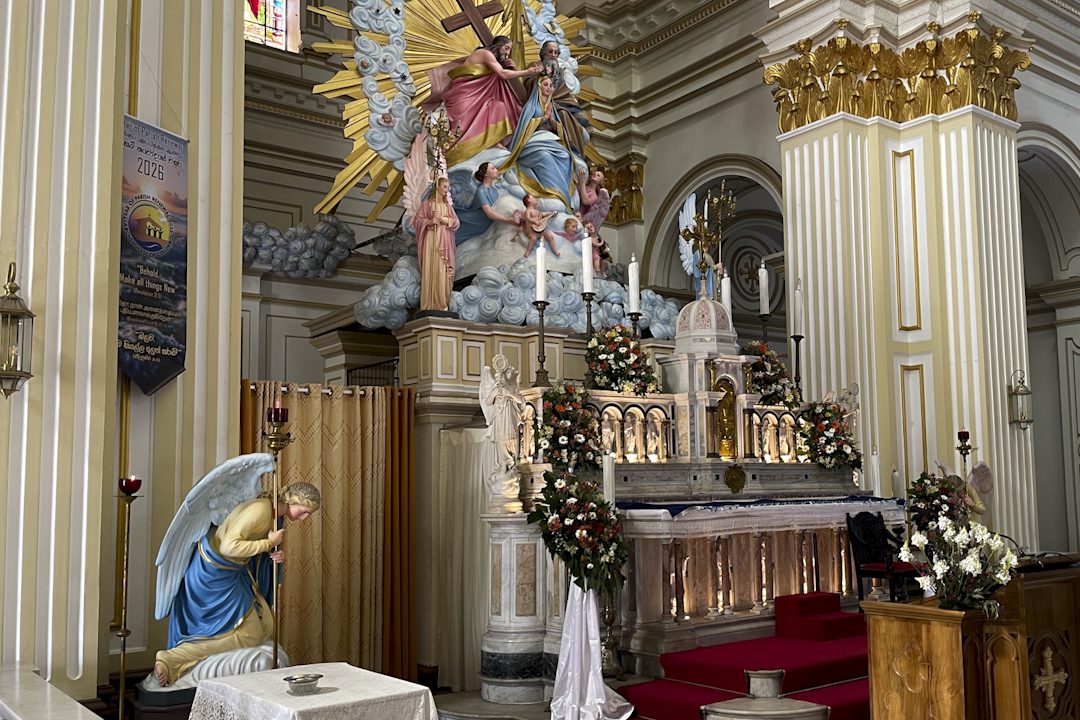
Why is Negombo known as ‘Little Rome’? A history of the Roman Catholic Church in Sri Lanka…
Few places in Asia display the legacy of European colonial Christianity quite like Negombo.
Known affectionately as ‘Little Rome’, this vibrant Sri Lankan coastal city is famous for its remarkable number of Roman Catholic places of worship.
Visitors are often surprised to discover magnificent Gothic-inspired churches standing alongside centuries-old Buddhist temples, Hindu kovils, and Muslim mosques.
But how did a predominantly Buddhist island come to have one town so strongly associated with Roman Catholicism?
The answer lies in more than five centuries of colonial history—first the Catholic Portuguese, followed by Protestant Dutch and British—and the zeal of generations of Sri Lankan Catholic clergy.
Meanwhile, it is not only a legacy of churches. The Portuguese also bestowed on Negombo such common surnames such as Fernando, Perera, Silva, De Silva, De Mel, Mendis, Peiris, Rodrigo, Fonseka, Corea, Pinto and Dias. (See footnote below).
So why is Negombo known as ‘Little Rome’?
Negombo earned the nickname ‘Little Rome’ because it has one of the highest concentrations of Roman Catholic churches in Sri Lanka.
In and around the city are dozens of parish churches, chapels, monasteries and convents, plus Catholic schools and charitable institutions.
Thus the city’s architectural landscape is dominated by church towers, many emulating signature European Gothic and Renaissance religious architecture and motifs.
Catholicism also became deeply embedded in local culture. Religious feast days, processions, Marian devotions, music, education and community activities continue to shape everyday life in many Negombo neighbourhoods.
And unlike those colonial legacies that faded after independence, Catholicism is still firmly rooted in local communities, especially those connected with Negombo’s traditional fishing industry.
Before the Portuguese: religion in Sri Lanka
Before the Portuguese arrived, Sri Lanka was overwhelmingly Buddhist, although Hinduism flourished in parts of the island and Muslim traders had established thriving coastal communities.
Negombo was already an important fishing settlement and trading port. Arab merchants had traded along Sri Lanka’s western coast for centuries, creating a cosmopolitan maritime society.
But it was the arrival of the Portuguese in 1505 that fundamentally altered the island’s political, commercial and religious landscape.
Their original objectives were strategic:
- Control the lucrative spice trade
- Establish naval bases
- Expand Portuguese influence in the Indian Ocean
- Spread Roman Catholic Christianity
However, the Portuguese Crown saw missionary work as an integral part of empire-building. Missionaries frequently travelled alongside soldiers and merchants.
Franciscans, Jesuits, Dominicans and Augustinians established churches throughout Portuguese-controlled coastal regions.
Thus Negombo soon became the epicentre of Catholic evangelisation in Sri Lanka.
The spread of Catholicism
Fishing communities often developed close relationships with Portuguese authorities because they depended upon coastal security and maritime trade.
Conversion also brought practical advantages, including military protection, commercial opportunities and closer political ties with colonial administrators.
Missionaries also devoted considerable effort to learning local languages and educating children.
Over time, conversion became more than simply adopting a foreign religion. Local traditions, family customs and Sri Lankan cultural practices gradually became intertwined with Catholic worship.
St Francis Xavier and the missionary movement
Although there is no conclusive historical evidence that St Francis Xavier visited Negombo, his missionary work in India and South Asia profoundly influenced the spread of Catholicism throughout the region.
Jesuit missionaries inspired by his work established missions across Portuguese territories, including Sri Lanka. Their emphasis on education, pastoral care and local engagement helped Catholicism develop lasting roots.
Churches built during Portuguese rule
Many of the earliest churches in Negombo were simple buildings constructed from timber, clay and thatch.
But as Catholic communities expanded, larger and more elaborate masonry churches replaced these earlier structures.
While some of today’s best-known churches stand on sites where Portuguese churches once existed, most date from later reconstruction during the Dutch and British periods.
The Portuguese introduced European architectural ideas, church organisation and parish administration that continued to influence Catholic development long after Portuguese political control ended.
Dutch rule: Catholicism goes underground
The Dutch captured Negombo in 1646. Unlike the Portuguese, the Dutch East India Company promoted Dutch Reformed Protestantism rather than Roman Catholicism.
Catholic churches were confiscated. Many priests were expelled. Public Catholic worship became heavily restricted.
Yet Catholicism did not disappear.
Instead, local believers maintained their faith privately in homes and secret gathering places. Lay leaders preserved religious traditions until Catholic priests could once again minister openly.
The work of Joseph Vaz
One of the most influential figures in Sri Lankan Catholic history was St Joseph Vaz, an Oratorian priest from Goa.
Arriving secretly during Dutch rule in the late seventeenth century, he travelled extensively across Sri Lanka disguised as a labourer and ministered to Catholics despite significant personal danger.
He celebrated Mass in secret, baptised converts, trained catechists and rebuilt Catholic communities that had survived decades of persecution.
His ministry strengthened Negombo’s Catholics and helped ensure the survival of Roman Catholicism throughout Sri Lanka.
He was later canonised by Pope Francis in 2015.
British rule and Catholic revival
British control began in 1796 and brought far greater religious freedom. Restrictions imposed under Dutch rule gradually disappeared. Catholic churches reopened.
New churches were built. Schools flourished. Religious orders established convents, orphanages and educational institutions.
Many of today’s landmark churches were constructed during this period, reflecting both European architectural styles and growing local prosperity.
Historically significant
These churches and shrines played a particularly important role during and after Portuguese rule (1505–1658):
St Mary’s – the symbolic heart of Catholic Negombo, begun in 1874 and completed in 1922.
St Sebastian’s (Sea Street) – one of the oldest fishing-community churches.
St Anthony’s Shrine, Dalupotha – a major national pilgrimage centre.
Our Lady of Good Voyage, Duwa – home of Sri Lanka’s famous annual Duwa Passion Play.
St Anne’s, Kurana – one of the oldest suburban parishes.
Our Lady of Sorrows, Kandawala – one of the historic Portuguese-era Catholic communities.
St Sebastian’s, Katuwapitiya – rebuilt after the 2019 Easter Sunday bombing and now an internationally recognised site of remembrance.
Education and social service
The Catholic Church’s influence extends well beyond religious worship.
- Catholic schools have educated generations of Sri Lankans from many different faiths.
- Religious orders have established hospitals, vocational training centres, orphanages and charitable organisations.
- Many respected educational institutions in Negombo continue this tradition today, combining academic excellence with community service.
- These institutions have contributed significantly to literacy, professional education and social mobility.
Negombo’s Catholic culture
Negombo’s Catholic culture possesses distinctive local characteristics.
Religious feasts often include:
- Colourful street processions
- Traditional Sri Lankan music
- Floral decorations
- Illuminated church grounds
- Community meals
- Maritime blessings for fishing communities
Living alongside other faiths
Although Negombo is famous for Catholicism, it remains religiously diverse.
Buddhist temples, Hindu kovils and mosques coexist throughout the city, and interfaith cooperation has generally been an important feature of local society.
A particularly telling aspect of Negombo is the close proximity of important Buddhist sites such as the historic Angurukaramulla Temple alongside major Catholic churches.
This reflects Sri Lanka’s broader religious diversity and demonstrates how different traditions have shared the same landscape for centuries.
The legacy of Portuguese rule
The Portuguese ruled only parts of Sri Lanka for around 140 years, yet their religious legacy proved remarkably enduring.
Their political power disappeared, and their military forts largely vanished or were rebuilt. But Catholicism remained.
Today, hundreds of thousands of Sri Lankan Catholics trace their religious heritage to the missionary efforts begun during Portuguese rule.
Negombo stands as perhaps the clearest example of this lasting influence. Its churches remain active places of worship rather than historical monuments, continuing traditions established more than five centuries ago.
Frequently asked questions
Why is Negombo called Little Rome?
Negombo is known as Little Rome because of its unusually large number of Roman Catholic churches, convents, schools and Catholic institutions, many of which originated during and after Portuguese colonial rule.
When did Catholicism first arrive in Negombo?
Catholicism was introduced shortly after the Portuguese arrived in Sri Lanka in the early sixteenth century, following their arrival in 1505.
Did the Portuguese build all of Negombo’s churches?
No. While the Portuguese established the earliest Catholic communities and churches, many of the impressive buildings visible today were rebuilt or expanded during the British colonial period and afterwards.
Who preserved Catholicism during Dutch rule?
Local Catholic families, lay leaders and missionaries—most notably St. Joseph Vaz—helped preserve the faith during periods of persecution and restrictions under Dutch rule.
Are Negombo’s churches still active today?
Yes. Nearly all serve active congregations and continue to host daily worship, weddings, feast days, charitable activities and community events.
Can visitors enter the churches?
Most churches welcome respectful visitors outside service times. Modest clothing and quiet behaviour are appreciated, and photography may be restricted during religious services.
A living heritage
Negombo’s churches are more than beautiful buildings. They tell the story of exploration, empire, cultural exchange, religious conviction and local resilience across more than five centuries.
The Portuguese introduced Catholicism, but it was generations of Sri Lankan believers who made it their own.
Through periods of colonial conflict, religious persecution and political change, the Catholic community endured and flourished.
Today, the soaring church spires of Little Rome remain among the defining features of Negombo’s identity.
Whether viewed as places of worship, architectural landmarks or windows into Sri Lanka’s complex colonial history, they offer visitors a deeper understanding of one of the island’s most distinctive and fascinating cultural landscapes.
Footnote: The legacy of Portuguese surnames
One of the most enduring legacies of Portuguese rule in Negombo is found not only in its churches but also in the surnames of thousands of local families.
Names such as Fernando, Perera, Silva, De Mel, De Silva, Mendis, Peiris, Rodrigo, Fonseka, Corea, Pinto, and Dias are immediately recognisable.
The widespread adoption of Portuguese surnames began during the sixteenth and seventeenth centuries as local people converted to Roman Catholicism.
At baptism, converts were often given Christian first names and Portuguese family names, sometimes adopting the surname of a priest, godparent, military officer or colonial official.
In many cases, entire families took the same surname, which was then passed down through successive generations.
Over the centuries, extensive intermarriage with Sinhalese, Tamil and other Sri Lankan communities created a population that is culturally and ethnically Sri Lankan while retaining these historic family surnames.
Together with Negombo’s churches, feast days and Catholic traditions, these names thus serve as living reminders of remarkable historical close encounters between Sri Lanka and Europe…